What each number means
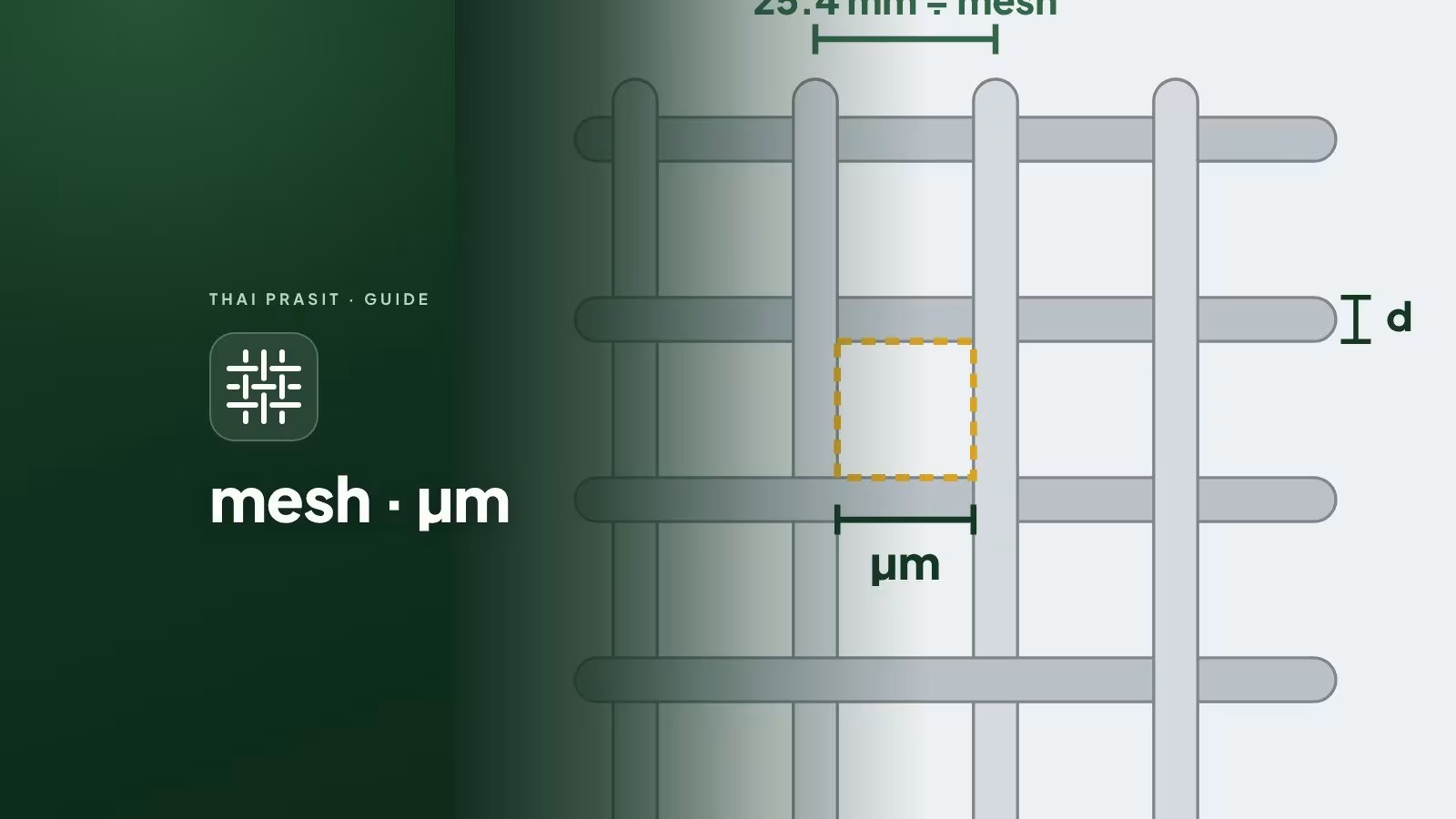
- Mesh count: the number of openings in 1 inch (25.4 mm). The higher the mesh, the smaller the openings.
- Wire diameter: the thickness of the wire, in millimeters.
- Opening: the clear gap between two wires, usually given in microns (1 mm = 1,000 microns).
- Open area: the share of the cloth that is open space, as a percentage. The higher it is, the more liquid or air can flow through.
Working out opening and open area
Opening (mm) = 25.4 ÷ mesh − wire diameter
Open area (%) = (opening ÷ (25.4 ÷ mesh))² × 100
Example: 20 mesh with 0.40 mm wire. The wire-to-wire pitch is 25.4 ÷ 20 = 1.27 mm, so the opening is 1.27 − 0.40 = 0.87 mm, or 870 microns, and the open area is (0.87 ÷ 1.27)² × 100 ≈ 46.9%.
The formula matches the figures in our plain weave specification table, for example:
| Mesh | Wire (mm) | Opening (µm) | Open area (%) |
|---|---|---|---|
| 10 | 0.45 | 2,090 | 67.71 |
| 20 | 0.40 | 870 | 46.93 |
| 40 | 0.23 | 405 | 40.68 |
| 60 | 0.15 | 273 | 41.69 |
Same mesh, different openings
One mesh count can be woven with several wire diameters. Thicker wire is stronger and wears longer, but the openings get smaller and flow is slower. When ordering, give both the mesh and the wire diameter, or the opening in microns that you need to filter.
Weave and filtering
- Plain weave: each wire passes over and under one wire at a time, giving square openings. The most widely used weave.
- Twill weave: each wire passes over two wires at a time, so heavier wire can be used at high mesh counts. Stronger cloth for filtering under pressure.
- Dutch weave: fine wires packed tightly in one direction, so there is no straight-through square opening. Fineness is given as a filter rating in microns. Used for fine filtering where the cloth must be strong.
Choosing a mesh from what you need to filter
- Start from what you need to catch: the opening must be smaller than the smallest particle you want to stop.
- Look at open area too: for thick liquids or fast flow, choose the option with more open area at a similar opening.
- For pressure or abrasion: choose a heavier wire, or twill weave, which takes more load than plain weave at a similar mesh.
- For micron-level filtering: see twill Dutch weave, rated 12–32 µm, or plain Dutch weave where a stronger cloth is needed.
- Not sure? Send a sample of what you need to filter, or the size in microns, and our sales team will match a mesh from the plain weave table.
What to tell us when ordering
- Weave
- Mesh and wire diameter, or the opening in microns
- Stainless steel grade, 304 or 316
- Width and length, or the size and shape of the finished part
- The application and what needs filtering, so our sales team can recommend a suitable specification